Martin Tarr

This is an extract from Rev Sheila Cameron’s sermon on 30 April, The Fourth Sunday of Easter, when she was reflecting on the story of Noah told in Genesis:
… Such Old Testament stories are the foundation of our Christian narrative and our New Testament or covenant with God through Jesus Christ. In the first covenant that God made with humans, he reassured Noah, who was a good and godly man, that he would never again destroy the earth; and, as we read in Genesis 9, the rainbow was given as a sign of that promise. The earth had become an evil and violent place but the Flood brought a fresh, new world living in a new relationship with its Creator. Our Christian baptism is a sign of our covenant with God through Christ: a covenant of grace offered unconditionally. All we have to do is accept in faith the offer of salvation through Christ, for we have inherited eternal life by being baptised into his death and resurrection.
The early Christians saw Noah as a character who called people to repentance; according to Clement of Rome, for example, writing around the year 96, “all who listened to Noah were saved.” The Ark soon came to be seen as prefiguring the Church, which came to be called the “ship of salvation.” …
Sheila went on to talk more about the ship image and the church, the way that the “community of salvation” operated and grew in the early church, and about Christ as our only means of access to salvation. Do read the whole of her sermon at this link.
Our photograph is of a section of the 11th-century murals illustrating the books of Genesis and Exodus on the ceiling of the barrel-vaulted nave of the Abbey Church of Saint-Savin-sur-Gartempe, in Poitou, France. If you don’t have time to visit, as your webmaster did, more delightful images can be found at https://tinyurl.com/mtnwjrud.
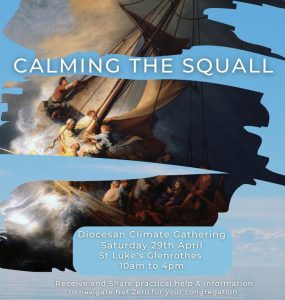
“Calming the Squall”, a Diocesan Climate Gathering, will be held at St Luke’s Glenrothes (Ninian Quadrant, Glenrothes, KY7 4HP) from 10.00am to 4.00pm on Saturday 29 April. This gathering is to receive and share practical help and information to navigate Net Zero for all congregations. There will be a plenary session, workshops and stalls addressing practical Net Zero implications and inspired by Mark 4.35–41. Tea and coffee will be provided: bring your own lunch or buy it at the nearby Kingdom Centre. Share in closing worship. For further information contact Gerry Dillon.

This is an extract from Rev Sheila Cameron’s sermon on 9 April, Easter Sunday, when she was expounding on John’s account of the resurrection in John 20:1–18:
… It’s Mary Magdalene, forgiven sinner, friend and devoted follower of Jesus, who takes centre stage in John’s resurrection story, and it is to her that Jesus entrusts the message to the community of his followers that he is alive. This is a very poignant encounter. Mary did not expect to see the face of Jesus again; she wept, not expecting consolation, knowing only loss. Her grief was compounded by the loss of Jesus’ body, all that remained of him. Things couldn’t get any worse. Then in the tomb she saw two angels who spoke comforting words of sorts: “Why are you weeping?” Maybe there was better news ahead.
In the ensuing encounter, as Jesus speaks Mary’s name and she recognises him, a profound change takes place in her relationship with him. She accepts with surprising equanimity that she cannot cling to him and must let him go; the important thing is that he is alive, though changed. He is on his way to his Father, and so cannot be with her or the disciples in the same way as before. The new relationship Jesus offers is still one of presence, but now a presence in another dimension that will last for ever.
God’s reassurance is not far off for those who seek him, as Mary Magdalene discovered. God does care about our griefs and longings and asks us to live in faith that our sorrows will be assuaged in him. This very human account of the resurrection invites us to reflect that love comes to maturity after death. We know that love is not limited by mortality; but that there are times in our lives when we can let go and entrust those we love to God. …
Do read the whole of Sheila’s sermon at this link.
This 1835 painting of Christ’s Appearance to Mary Magdalene after the Resurrection by Russian painter Alexander Andreyevich Ivanov (1806–1858) in the State Russian Museum, St Petersburg, is made available via Wikimedia Commons at this link.
