Martin Tarr

Last Sunday was Trinity Sunday, so Rev Sheila Cameron joined the many preachers struggling to define and explain the difficult concept of the Holy Trinity! Here are some of her thoughts:
Our three-personed God should not be seen as one person wearing three different hats, or operating in three separate modes, but as a unity of three persons who have co-existed from the very beginning … inseparable in the creation, the redeeming and sustaining of the world.
… A(nother) helpful image of the Trinity I’ve come across is that of light: think of the light produced by a candle, where the three elements of wax, wick and flame come together simultaneously to create light. No one part can provide light without the presence of the other two; all three parts need to combine for the whole to realise its purpose of bringing light into darkness.
… We say that God is love, and this is another image that demands threefold participation: for divine love, like all loves, cannot exist without the threefold interaction of the one who loves, the one who is loved and the love itself that binds them together. And through the beloved Son, Jesus Christ, in his relationship with God the Father, we too are drawn into that fellowship of love with God and with one another.
I’ve come to see that our three-personed God contains everything our human nature requires in one true God who is creator, redeemer and sustainer. The created world of which we are a part is a place of poignant beauty: poignant because it contains pain and imperfection, loss and unfulfilled longing. But our faith teaches us that we’re moving onwards towards perfection, the perfect creation that exists in the mind of God the Father, and we believe we can do this only through the gift of Jesus, the Son. … Our ultimate destiny is union with God in glory and divine perfection. We need to be redeemed, forgiven and reconciled to our creator and to one another; and in the absence of the physical Jesus we need to be sustained and blessed in our daily struggle by that third person of the Trinity, God’s Holy Spirit – dwelling within us, among us, and in our world.
Do read the whole sermon, which is available at this link.
Our picture is of the floral arrangement at Rosyth Methodist Church created for Trinity Sunday by Val Leslie.
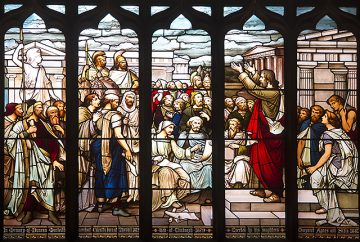
Below are some extracts from Rev Sheila Cameron’s sermon on 14 May 2023, when our readings had included Acts 17:22–31 and John 14:15–21.
How we need that “Spirit of truth” that Jesus speaks of in today’s Gospel!The church has always had a tough challenge standing up to the spirit of the age and, as Christians, we need to gather together in places of safety in the midst of the storms of scepticism and materialism that assail us …
In the Easter season we draw inspiration from the Acts of the Apostles, which tells a story of great courage and joy and spiritual power in the face of an equally sceptical audience. Today’s reading starts at the beginning of a great speech by Paul to the Athenians, but the verse just before it gives us an interesting glimpse of life in ancient Athens. The Revised English Bible has the translation: “Now, all the Athenians and the resident foreigners had time for nothing except talking or hearing about the latest novelty.” This was a world very like our own, restless, endlessly seeking fresh stimulation and new versions of everything, unable or unwilling to commit to anything in much depth or settle down in one place for long: perhaps because the one commitment that might be the key to life, the commitment to Jesus Christ, had so far eluded them.
In Acts 17, we see Paul addressing the scepticism of his own age, and pointing to the hunger for truth that lay behind it. The Areopagus was a large rock in the centre of Athens which served as a public forum and a place of trial, and Paul was taken there to be interrogated about the new faith in Jesus and the Resurrection which he had been preaching around the city.
…
What is so enormously impressive about this speech is how Paul identified with his audience. He showed them how familiar he was with their thinking; he referred to their commonly held beliefs – that there was a creator god; that this god had no need of anything from humans, including being worshipped in temples built by human hands; and yet this god was available to those who reached out to him.
…
Paul won the respect of his hearers, and what an important lesson that is for all of us. In the sharing of our faith it is so important to establish a foundation of common ground with our neighbours, to be friendly and concerned, generous and respectful. We don’t need to quote the Bible or recite the history of the church to explain the gospel. Shared culture, shared history, concern for others, common life experience and above all, willingness to spend time with others all provide excellent starting points to begin communicating our faith by our presence, interest, kindness, good humour and joy.
Do read the whole sermon, which is available at this link.
Our picture is of a stained glass panel that you can see at St Giles’ Catherdal, Edinburgh, made available through WikiMedia Commons at this link.
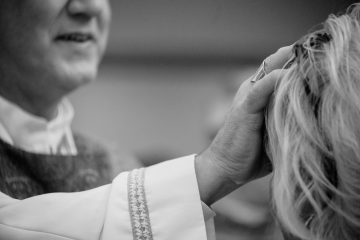
This is an extract from Rev Sheila Cameron’s sermon on 7 May 2023, The Fifth Sunday of Easter, when she was reflecting on our readings in the light of the Coronation of King Charles III the previous day:
Today, as we look forward to Pentecost and the coming of the Holy Spirit, our readings celebrate the status of Christians as God’s chosen people, divinely gifted, and celebrated in that rich variety of images in 1 Peter: we are not only “the stones that the builders rejected,” but also “a chosen race, a royal priesthood, a holy nation, God’s own people.”
You’d be forgiven for thinking there are just too many images here to get your head around. But Christians are all these things, because as followers of Jesus, we have been gifted with the Holy Spirit. The journey begins with baptism, and that includes the gift of the Spirit, a sign of which in our Anglican tradition is the anointing of every new Christian with the oil of chrism …
Yesterday’s moment of anointing, or Act of Consecration, was veiled from the eyes of the public, hidden from the cameras, kept as a moment of deep personal encounter between the new sovereign and God. Like our Lord Jesus Christ, King Charles was anointed “not to be served but to serve.” The moment of anointing was similar to baptism, in the eyes of Christians a transformative moment of encounter and divine gifting.
We read in Acts today of one particular life transformed by the gift of the Spirit, challenged in a way that was irresistible. The death of the first martyr, Stephen, is a shocking story, and yet the focus is not on the violence but rather on the radiance that shines from the face of Stephen. He was “filled with the Holy Spirit, he gazed into heaven and saw the glory of God and Jesus standing at the right hand of God” (Acts 7:55). Like Christ on the mountain, he was transfigured. …
Do read the whole of Sheila’s sermon at this link.
Our picture by Matea Gregg is a slightly lightened version of the one made available on the Unsplash platform.
