A Thought to Share
This category was formerly called “Thought for the Month”
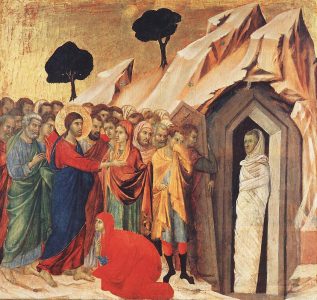
This is an extract from Rev Sheila Cameron’s sermon on 26 March, the Fifth Sunday of Lent, when she was expounding on two resurrection passages in Ezekiel 37:1–14 and John 11:1–45:
… what does Jesus’s promise of resurrection mean for us here and now? Whatever our circumstances: whether someone is a young person and still a bit uncertain of their identity, or a so-called ‘mature’ person advanced in years, whether they’re struggling in mid-life with money, career or family issues, or battling with ill health or the loss of physical strength in old age, these words of Jesus, “I am the resurrection and the life,” carried in the heart and recited in faith will bring comfort and restoration and enable each one of us to face the future with confidence.
These are words that have inspired whole nations to seek freedom and human dignity, as well as being most potent in the lives of individual Christians. The idea that we can overcome the flesh, that is, our limited physical existence in a body subject to sin and decay, and live anew, here and now, inspired the movement to liberate the poor from political and economic oppression in South America in the 1970s and 80s. One of the fathers of that movement in the Catholic Church wrote that Paul’s teaching in Romans 8, that setting the mind on the flesh brings “death” while setting the mind on the Spirit brings “life and peace”, combined with Paul’s idea of the church as the body of Christ – makes the Church a very powerful agent of transformation in the lives of poor people and enables them to take charge of their own destinies.
Do read the whole of Sheila’s sermon at this link.
The Raising of Lazarus, painted in Siena by Duccio di Buoninsegna and in the collection of the Kimbell Art Museum in Forth Worth, Texas, is made available by the Web Gallery of Art at this link.

This is how Rev Sheila Cameron finished her sermon on 5 March, the Second Sunday of Lent:
During Lent, let us think about those risky journeys of Abraham and Nicodemus and of Jesus himself, and about what journeying might mean to each of us. What are the comforts you would need to think about renouncing, if you believed God was calling you to take a step into the unknown? These might be material things such as home comforts; or they might be favourite plans that don’t necessarily include God; or they might be attitudes of mind that put self before discipleship. Whichever category your sacrifice comes under, it won’t be comfortable, but you will be listening for a call to a greater purpose beyond that sacrifice. The present may be darkness, but faith keeps us steady and teaches us patience. And the future holds promises beyond our imaginings.
So, as we make our personal journey of discipleship through Lent, let us empty our hearts and minds of all that distracts us, so that we can, in the words of Henri Nouwen, “prepare in the centre of our innermost being the home for the God who wants to dwell in us. Then we can say with St Paul, ‘I live now not with my own life but with the life of Christ who lives in me’ (Galatians 2:20).” And in this we’ll have a safe home while we are still on the way. Amen.
Do read the whole of Sheila’s sermon at this link.
Our picture by Aram Sabah is a slightly cropped version of the one made available on the Unsplash platform.

Below are two extracts from Rev Sheila Cameron’s sermon on Ash Wednesday, 22 February 2023, when our readings had included Isaiah 58:1–12 and John 8:1–11.
We are all beloved children of God, but we must “participate in our own redemption.” Today, at the beginning of Lent, our liturgy invites us to enter the darkness of our sin, to recognize it for what it is and face the pain it has caused ourselves and others. We may find consolation in the thought that our sins are perhaps less extreme than other people’s but so, of course, did those preparing to stone the woman caught in adultery. It’s not our business to feel holier than others and to cast stones at others, but to know that our nature is flawed and reflect on our own shortcomings.
…
Isaiah warns us not to pay mere lip-service to our liturgy this morning, for receiving ashes on our faces will do us no good at all if our hearts are hardened towards the needs of those around us. We are entering what our liturgy calls a “desert of repentance,” forty days of reflecting on how we might be God’s people once again. This, we’re told, is a journey of discovery, “a pilgrimage of prayer and discipline” through which we hope to reconnect with the God we have offended by our sinfulness and our disregard for the welfare of others.
The promises of renewal are there in our reading from Isaiah: the promise of light breaking into our darkness like the dawn, of healing springing up quickly, of the glory of God shielding and protecting us. In this place of contrition, our prayers will be answered, for God never disregards a cry from a broken and a contrite heart. We wait sorrowfully and yet expectantly, and it’s best if we don’t anticipate anything precise, for when the light comes it will certainly arise in unexpected places.
Do read the whole sermon, which is available at this link, if only to read the first illustration! Sheila ended quoting and commenting on sections of Louis Untermeyer’s poem, Ash Wednesday, which you can read in full on-line at this link.
Our picture is the one taken by our friend Liz Crumlish to accompany the Ash Wednesday 2023 thought on her blog, and can be seen in context at this link.
